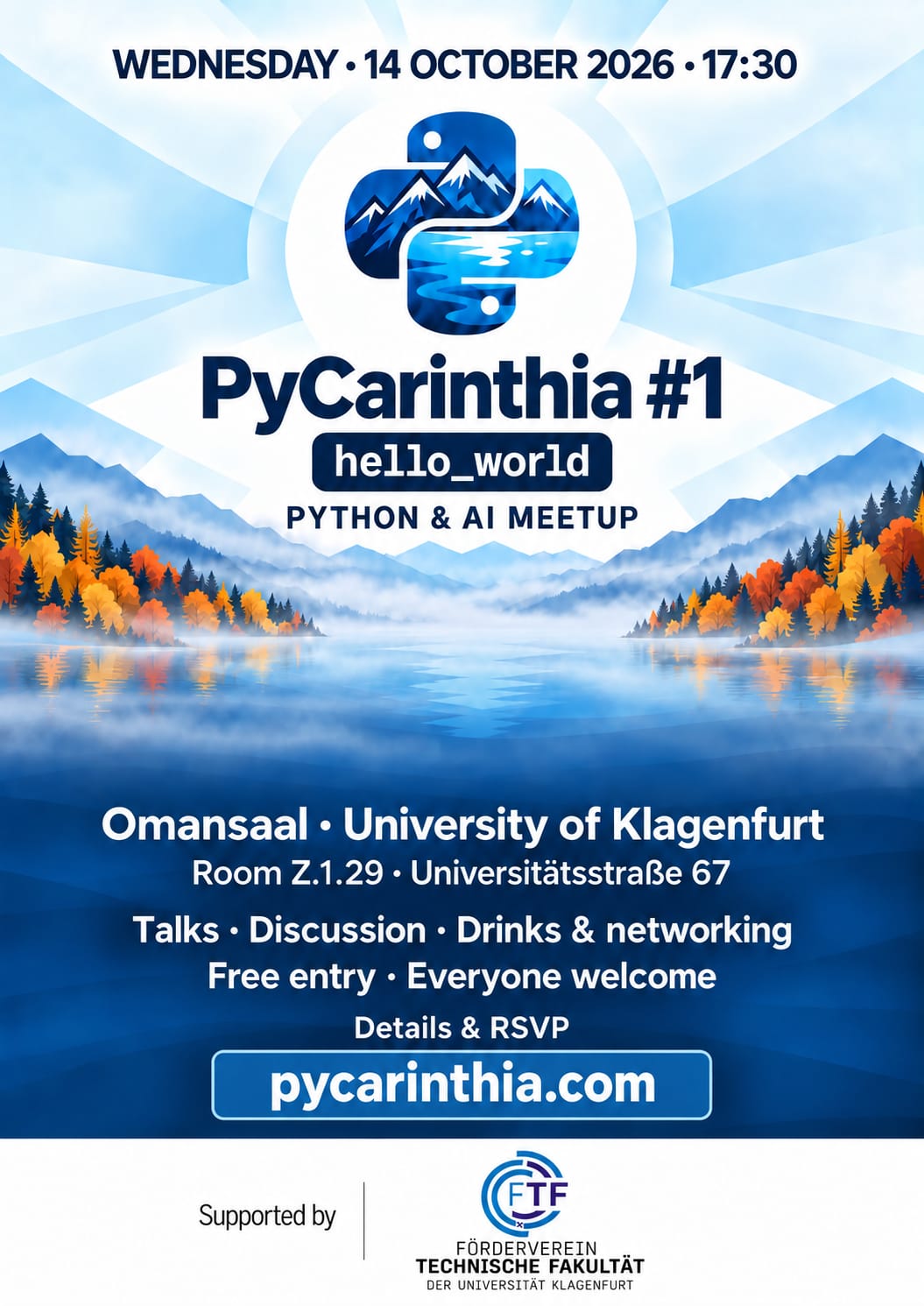
PyCarinthia #1 – hello_world – The kick-off for Carinthia’s Python and AI community

PyCarinthia is a new volunteer-run community for everyone in Carinthia who works with Python and AI or is curious about them: students, researchers, developers and hobbyists alike. The first meetup is about getting to know each other and shaping the community together. No prior knowledge needed, just curiosity.

PROGRAMME

  • Welcome and a short introduction to PyCarinthia
  • Benjamin Hackl (Manim maintainer): „Musings from Maintaining Manim“

Behind the scenes of Manim, the Python library for mathematical animations: live demo, his route into open source, community building and dealing with AI slop.

  • Alina Nessel (self-employed, builds AI phone assistants): „LiveSaferOverview: Saving Lives in Tunnels with AI“

How an AI trained on 80,000 images tracks emergency vehicles through existing tunnel cameras and shows their positions on a real-time map on a smartphone, so rescue teams at highway tunnel accidents don’t lose critical minutes.

  • Christian Klimbacher (IT System Engineer at Nittoku Europe GmbH): „When AI Calls a Multimeter for Help, You Get More Than Expected“

How a Python system combines a photo of an unknown circuit board, datasheets and multimeter readings to work out component values, with a live measurement on stage.

  • Open discussion and drinks

RSVP via Meetup: https://www.meetup.com/pycarinthia/events/316488225/

More info: https://pycarinthia.com/events/kickoff-python-ai-carinthia/


Posted in Veranstaltungen, TEWI-Kolloquium, News | Kommentare deaktiviert für PyCarinthia #1 – hello_world – The kick-off for Carinthia’s Python and AI community

Three Research Area Managers

Posted in Stellenausschreibungen, News | Kommentare deaktiviert für Three Research Area Managers

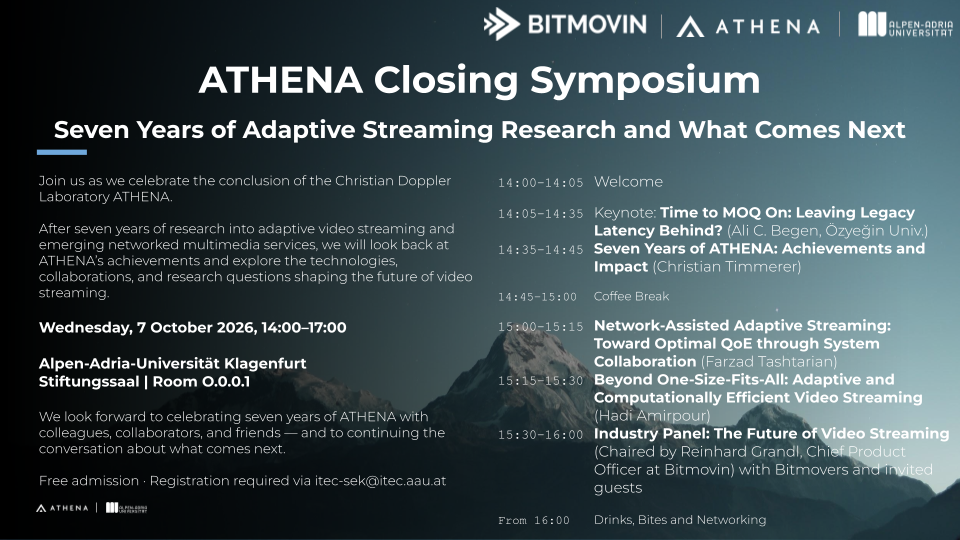
ATHENA Closing Symposium

After seven years of successful research, the Christian Doppler Laboratory ATHENA is approaching its conclusion. We would like to celebrate this special milestone together with our colleagues, partners, and companions and warmly invite you to our closing event:

Wednesday, 7 October 2026, 14:00–17:00

University of Klagenfurt

Stiftungssaal, Room O.0.0.1

https://athena.itec.aau.at/2026/09/athena-closing-symposium/

During the event, we will look back at ATHENA’s key achievements and results. The program includes a keynote, an overview of seven years of research, selected technical talks on current developments in adaptive video streaming, and a panel discussion with representatives from academia and industry.

Afterwards, we invite you to join us for refreshments, networking, and informal conversation.

You will find the detailed program in the attached invitation. Attendance is free, but registration by email to itec-sek@itec.aau.at is required. We would be delighted to welcome many colleagues from our faculty to this special occasion.

Best regards, Christian Timmerer

Univ.-Prof. DI Dr. Christian Timmerer | ITEC, Alpen-Adria-Universität Klagenfurt | Bitmovin

Business Card | christian.timmerer@aau.at | LinkedIn


Posted in TEWI-Kolloquium | Kommentare deaktiviert für ATHENA Closing Symposium

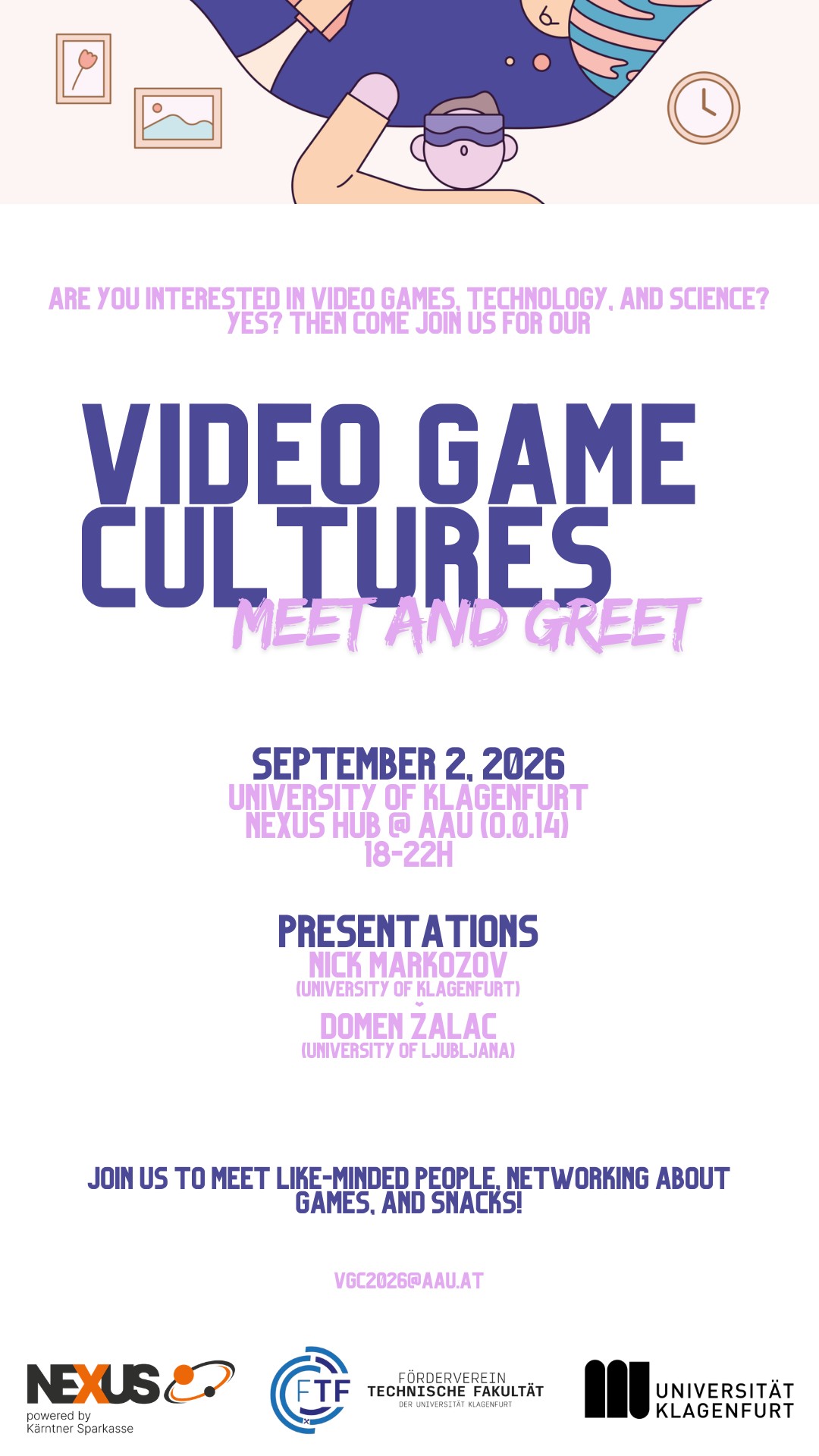
Video Game Cultures Meet & Greet

Are you interested in video games, technology, and science?

Then come join us on September 2, 18:00, at the Nexus Coworking Space on AAU Campus, located in the side building near the main entrance, for a special event supported by the Förderverein Technische Fakultät.

The evening opens with guest presentations by Nick Markozov (Game Studies and Engineering Master’s Programme, University of Klagenfurt) and Domen Žalac (University of Ljubljana), showcasing how you can find your way into studying and/or working with video games.

From 19:30 to 22:00, you are kindly invited to stay for meeting like-minded people, networking, and snacks!

Posted in TEWI-Kolloquium | Kommentare deaktiviert für Video Game Cultures Meet & Greet

„Building Intelligent CI Systems: Reducing Build Overhead with Prediction, Dependency Analysis and Automated Repair“

Presentation of the habilitation project

Friday, June 26, 2026 | 10:00 a.m. | Room: S.2.69 | University of Klagenfurt

Postdoc-Ass. DI Dr. Christian Macho

Department of Informatics Systems | University of Klagenfurt

Abstract: Continuous Integration (CI) has become an essential practice in modern software development, enabling rapid feedback through automated building and testing of software systems. However, projects grow in size and complexity. As a consequence, such CI pipelines increasingly suffer from high execution costs, dependency-related failures, and build breakages that require substantial developer effort to diagnose and repair. In this talk, I will present my research agenda on intelligent build engineering that combines prediction, validation, and automated repair techniques to improve the efficiency and reliability of software builds. First, I will discuss approaches for anticipating build outcomes and identifying skippable CI commits, leveraging both changes to source code and to build code, along with complexity measures, to enable more efficient CI utilization. Next, I will introduce my approaches for validating dependencies in build configurations and automatically detecting and repairing dependency conflicts, including approaches that leverage large language models to modify source code when configuration-level fixes are insufficient. Finally, I will explore the emerging role of AI agents in build maintenance. This includes evaluating whether large language models can replace traditional build log analyzers, as well as presenting agent-based approaches for diagnosing dependency-related failures and repairing such build breakages automatically. In summary, my research directions investigate how predictive analytics, dependency management, large language models, and autonomous agents may enable future CI systems that are faster, more resilient, and increasingly self-healing.

Bio: Dr. Christian Macho is a Postdoctoral Researcher (tenure-track) in the Software Engineering Research Group at the University of Klagenfurt, where he works on software evolution, program analysis, build systems, continuous integration, automated repair, and empirical studies in software engineering. He earned his MSc from the Technical University of Vienna and his PhD from the University of Klagenfurt, both with distinction. His work has contributed to understanding how software systems evolve and how development tools can more effectively support developers, particularly when building software projects. He has served on program committees for major software engineering conferences, was recognized as a top reviewer for the Journal of Systems and Software (JSS), and was a Distinguished Reviewer for the International Conference on Mining Software Repositories (MSR) 2025.

VIDEO: https://youtu.be/1PVLdfXpsQE


Posted in Veranstaltungen, TEWI-Kolloquium | Kommentare deaktiviert für „Building Intelligent CI Systems: Reducing Build Overhead with Prediction, Dependency Analysis and Automated Repair“

From moving bits to moving minds: research at SINLab

Wednesday, June 24, 2026 | 02:00 p.m. | Room: N.1.04 | University of Klagenfurt

Prof. Carsten Griwodz 

Networks and Distributed Systems | University of Oslo

MishMash role: Work Package Leader Group member

Abstract: This talk will introduce the research of SINLab, the Sustainable Immersive Networking Lab, at the University of Oslo. Our applications are diverse, and range from music making to working on assembly lines, and also our investigations range from the efficient parallelization of media-specific algorithms to quantitative user experiences. Through all of this, we explore how humans perceive audiovisual and tactile experiences. Our research questions are concerned with the disconnect between local environments and those that are remote in time and space. We answer questions like: „To which extent can Redirected Walking help you to experience unconstrained virtual worlds through natural movement?” and “How can we overcome the delay challenges when you act remotely in first person through a robot arm and hand?”. My talk will introduce these questions in some detail and give an overview of our findings so far.

Bio: Carsten Griwodz is a professor at the University of Oslo. He received his Diploma in Computer Science from the University of Paderborn, Germany, in 1993. He worked at the IBM European Networking Center in Heidelberg, Germany, before joining the Multimedia Communications Lab (KOM) at Darmstadt University of Technology, Germany. There, he obtained his doctoral degree in 2000 and joined the University of Oslo in the same year. He worked at Simula Research Laboratory from 2005 to 2018. He has been a member of ACM since 1996 and of IEEE since 2011. At the University of Oslo, he was previously group leader of “Networks and Distributed Systems” and, from 2020 to 2025, head of the section for Distributed Infrastructures and Security.

His research interest is the performance of interactive multimedia systems. He explores research advances in fields ranging from networks and operating systems to computer vision to understanding how humans reach the point of sufficient immersion. His goal is to understand how users can become sufficiently immersed in an experience depending on their goals and context. He belongs to the Sustainable Immersive Networking Lab, a diverse group of people who aim at the improvement of human experiences in immersive remote presence.  He is a work package leader of the AI Center „MishMash Centre for AI and Creativity”, the only Norwegian AI Center focussed on Creativity, leads MIRAGE (“Multimodal Immersive Interactions for Remote Education Across Geographically Distributed Sites”) and partner in DRIVE (“Brain-driven Remote Collaborative Physical Work”).

Video: https://youtu.be/jNF7ZiNtJ5I

Posted in TEWI-Kolloquium | Kommentare deaktiviert für From moving bits to moving minds: research at SINLab

Neural Network based Video Coding: Opportunities & Challenges

Friday, June 12, 2026 | 10:00 a.m. | Room: V1.03 | University of Klagenfurt

Prof. Hui Yong Kim | Dept. of Computer Science and Engineering and Dept. of Artificial Intelligence | Kyung Hee University

Abstract: Up to now, video coding standards have been developed as a combinatory set of a large number of coding tools. Each tool was primarily based on signal-processing algorithms or experimental optimizations. Recently, a new paradigm called Learned Video Coding (LVC), a.k.a. Neural Network-based Video Coding (NNVC), has emerged. By exploiting the end-to-end training with a large number of video datasets, some representative models already outperform the latest video coding standard, VVC (Versatile Video Coding). In this talk, the LVC technology will be briefly outlined and then the opportunities and remaining challenges will be discussed.

Bio: Hui Yong Kim is a Professor in the School of Computing (Dept. of Computer Science and Engineering and Dept. of Artificial Intelligence) in Kyung Hee University, Yongin, Korea since Mar. 2020. He was also an Associate Professor in the Dept. of Electronics Engineering in Sookmyung Women’s University, Seoul, Korea. Prior to joining universities, he served as the Managing Director of Realistic Audio & Video Research Group of Electronics and Telecommunications Research Institute (ETRI), Daejeon, Korea from 2005 to 2019. From 2003 to 2005, he worked for AddPac Technology Co. Ltd. as the Multimedia Research Team Leader.

He received his BS, MS, and Ph.D degrees from Korea Advanced Institute of Science and Technology (KAIST) in 1994, 1998, and 2004, respectively. He was also an affiliate professor in University of Science and Technology (UST) and was a visiting scholar in the Media Communications Lab. at University of Southern California (USC), USA. He has published more than 70 papers on international journals and conferences, and holds more than 500 registered patents over the world. He has been an active technology contributor, editor, and ad-hoc group chair in developing several international standards including MPEG Multimedia Application Format (MAF), ITU-T/ISO/IEC JCT-VC High Efficiency Video Coding (HEVC) and JVET Versatile Video Coding (VVC). His current research focus is neural-network based visual data compression, including learned video compression, digital hologram compression and deep feature compression for machine vision.

SLIDES: https://de.slideshare.net/slideshow/neural-network-based-video-coding-innovations-standards-and-challenges-in-visual-media-compression/288070227

VIDEO: https://youtu.be/_oAppelJmpE


Posted in TEWI-Kolloquium | Kommentare deaktiviert für Neural Network based Video Coding: Opportunities & Challenges

Guest Lecture and Workshop by Immera

We supported it!

On 16 April, Dr Felix Schniz (ITEC) organized a guest talk and workshop by Flavia Mazzanti and Manuel Bornell from Immerea (www.immerea.com). Supported by the FTF and co-organized by DI Dr. Martina Tritthart (Visuelle Kultur), the dual event introducedstudents of both programs alike to contemporary digital art in the era of VR technologies, computer graphics, and generative AI under an interdisciplinary, technology-oriented angle. While the guest talk focused on the recent art installations of Immerea, the workshop allowed participants to explore opportunities in the creation of arts via Blender and other common tools firsthand. Both events were well visited, highlighting the drawing power of cutting-edge technology research from a humanities, tech-interested perspective.


Posted in Veranstaltungen, News | Kommentare deaktiviert für Guest Lecture and Workshop by Immera

Special Guest Talk & Workshop

Thursday, April 16, 2026 | 11:45 a.m. | HS 10 (Mensa Building) | University of Klagenfurt

from  11.45 a.m. to 01.00 p.m., we kindly invite you to join us in HS 10 (Mensa building) for a very special guest talk.

The guest talk will continue in a special guest workshop, beginning at 02.00 p.m. and ending at around 06.30 p.m. at the Game Lab (B12a.2.2.1)

Flavia Mazzanti and Manuel Bonell | co-founders of Immerea


Talk: “Interdisciplinary Approaches in Artistic Practices”

Interactive media and experimental games increasingly emerge at the intersection of creative practice and technological development. As media artists and VR developers, our work is shaped by interdisciplinary collaborations that combine and experiment with elements from animation films, art installations, spatial environments, and immersive technologies. This talk presents our creative practice and reflects on interdisciplinary approaches and possibilities for artistic projects.

The speakers: Flavia Mazzanti and Manuel Bonell from Immerea (Immerea.com)

Flavia Mazzanti and Manuel Bonell are co-founders of Immerea, a Vienna-based indie studio dedicated to VR games and interactive installations. Their interdisciplinary practice explores new modes of perception and interaction in virtual and hybrid spaces, with a strong focus on artistic quality and level of experimentation Their work has been exhibited internationally at institutions and festivals including Ars Electronica (Linz), DIG Shibuya (Tokyo), KunstHaus Wien (Vienna), Kunsthaus Graz, FILE Festival (São Paulo), MESH Festival (Basel), DA Z – Digital Arts Festival Zurich, and ADAF – Athens Digital Arts Festival. Alongside their studio practice, they are both active as university lecturers, speakers, and co-organizers of XR Austria, Austria’s largest community for immersive technologies.


Workshop: “Aesthetics of Play: Visual Languages and their Influence in Video Games”

The workshop explores how aesthetics shape the identity, atmosphere, and narrative potential of video games. Through collaborative experimentation and visual research, participants will engage with references from games and art to develop their own aesthetic approaches. Starting from a shared scenario, the workshop opens a space to explore how visual choices can unfold into different worlds, narratives, and player experiences.


(picture: https://www.immerea.com/)

Posted in Veranstaltungen, TEWI-Kolloquium | Kommentare deaktiviert für Special Guest Talk & Workshop